
Defence — Canada · Synthesis
One of NATO's lowest defence efforts, below the 2% of GDP target, protected by geography and the alliance with the United States (NORAD) — but under growing pressure to reinvest, particularly in the Arctic.
Citoyen synthesis for the Defence category in Canada. Grounded in the sector's quantitative data (Department of National Defence, SIPRI, IISS). All values are the latest realized observation available — never a forecast. Assessments are kept distinct from sourced facts. Data last updated: June 2026.
1. State of play — where Canada's defence stands
One of NATO's lowest defence efforts. Canadian military spending amounts to approximately 30 billion dollars (of the order of 1.3 to 1.4% of GDP, SIPRI), well below the NATO 2% target. Canada regularly figures among the Alliance members that spend the least, which draws criticism from its allies.
A protective geography. Canada's geographic position (vast territory, oceans, American neighbourhood) has long reduced the sense of direct threat and justified a moderate defence effort.
The alliance with the United States (NORAD). The defence of the North American continent rests on NORAD, the integrated Canada-US aerospace defence command — a structural dependence on the American ally.
Moderately sized armed forces. The Canadian Armed Forces have moderate personnel numbers and face recruitment and equipment challenges (availability, modernisation) flagged by the Parliamentary Budget Officer.
No nuclear deterrence. Canada does not possess nuclear weapons and relies on NATO's and the United States' deterrence.
“Canada is among the NATO members that spend the least on defence, below the 2% of GDP target.”
2. Outlook — where defence is heading
Reaching 2% of GDP. Under pressure from its allies and in light of the international context, Canada has committed to increasing its spending towards the 2% of GDP target — a significant effort given the low starting point, the timeline and funding of which are under debate.
The Arctic. The defence of the Arctic, exposed to warming (opening of sea routes) and to Russian and Chinese ambitions, is becoming a major strategic priority, calling for investment (surveillance, NORAD, presence).
Modernisation and recruitment. Modernising equipment (aviation, navy) and resolving recruitment and retention difficulties are central undertakings.
Relationship with the United States. The dependence on the American neighbour for continental defence makes the bilateral relationship decisive, in a context of uncertainty.
The open questions. Three trade-offs will shape the period: (1) increasing the effort towards 2% of GDP; (2) investing in the Arctic; (3) modernising and recruiting for the armed forces.
“Protected by its geography and the American alliance, Canada is under pressure to reinvest, particularly in the Arctic.”
3. International comparison — Canada among the military powers
Placed in its environment, Canada has one of the lowest defence efforts among the major democracies, protected by its geography and the American alliance.
Three takeaways. (1) A relatively low effort. At ≈ 1.3-1.4% of GDP, Canada is below the NATO target and behind France (≈ 2.0%), the United Kingdom (≈ 2.3%) and Germany (≈ 2.1%), at a level close to Italy (≈ 1.5%).
(2) No nuclear capability, dependent on the United States. Like Germany and Italy, Canada does not have nuclear weapons; its continental defence rests on NORAD and the American ally.
(3) A growing Arctic challenge. The defence of the Arctic is a strategic dimension specific to Canada (alongside Russia and the Nordic countries), which drives reinvestment.
International comparison — defence efforts
| Country | Budget (~billion dollars) | % GDP | Nuclear deterrence |
|---|---|---|---|
| United States | ≈ 900-970 | ≈ 3.4% | ✓ |
| United Kingdom | ≈ 75-94 | ≈ 2.3% | ✓ |
| Germany | ≈ 90-114 | ≈ 2.1% | ✗ |
| France | ≈ 60-67 | ≈ 2.0% | ✓ |
| Italy | ≈ 30-40 | ≈ 1.5% | ✗ |
| Canada | ≈ 30 | ≈ 1.3-1.4% | ✗ |
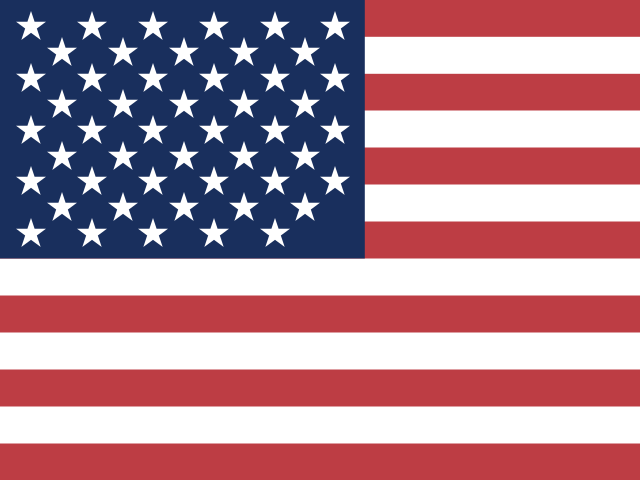
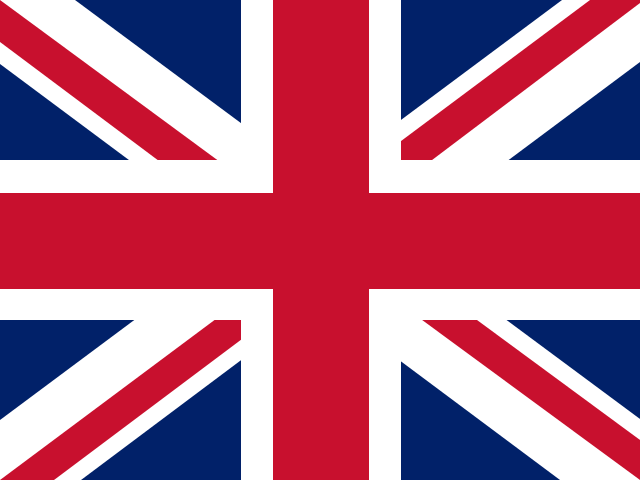

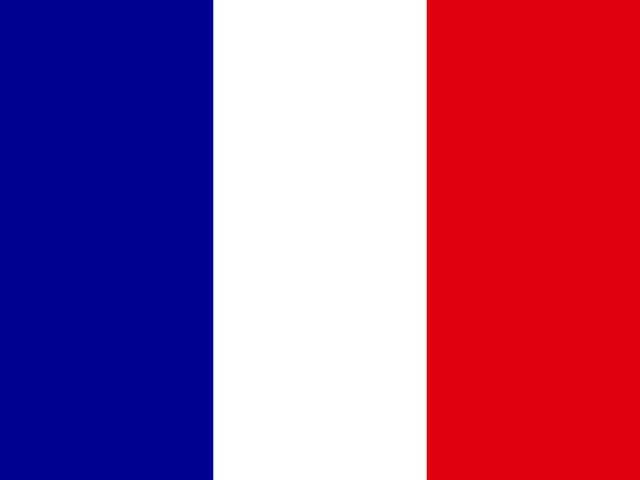

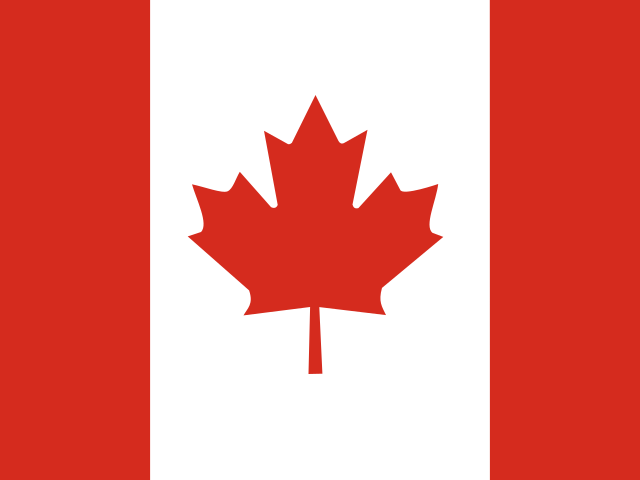
Sources: SIPRI & IISS (budgets) — latest realized values available. Ranges reflect differences in scope and year. "≈" denotes a rounding.
Data mobilized (data-journalism base)
| Data | Value | Source |
|---|---|---|
| Military spending | ≈ 30 billion dollars | SIPRI (Citoyen chart) |
| Share of GDP | ≈ 1.3-1.4% (below NATO target) | SIPRI / NATO (Citoyen chart) |
| Nuclear deterrence | none (NATO / US) | IISS |
| Continental defence | NORAD (with the United States) | Department of National Defence |
| Emerging priority | Arctic | Department of National Defence |
Sources (national analyses and references)
Department of National Defence (budget, posture, Arctic) · Parliamentary Budget Officer (PBO — costs, equipment) · NORAD · SIPRI (Military Expenditure) · IISS (Military Balance).
Methodological note — the synthesis keeps sourced facts distinct from assessments, stays neutral, dates each figure, and does not extrapolate beyond the sources. Budgets vary by scope and year (ranges). All values are the latest realized observation available (no forecast). Note generated by AI, human review required. Same safeguards as the rest of the observatory.