
Trust in institutions — China · Synthesis
An authoritarian single-party regime where Western indicators of trust and democracy do not apply: surveys report high satisfaction with the authorities, but within a framework that prevents free interpretation.
Citoyen synthesis for the Trust and democracy category in China. ⚠️ Major warning: China is an authoritarian single-party regime with no free elections or freedom of expression. Opinion surveys there are strongly biased (self-censorship, fear, state sponsorship) and indicators of 'trust' or 'democratic satisfaction' are not interpretable in the same way as in a democracy. This note prioritizes international governance indices and flags these limitations. All values are the latest realized observation available. Data last updated: June 2026.
1. State of play — where trust stands
An authoritarian single-party regime. China is governed by the Communist Party, with no free national elections, no separation of powers and no press freedom. International indices (V-Dem, Freedom House, Economist Democracy Index) rank it among the least democratic regimes — a framework that conditions all readings of trust indicators.
Biased satisfaction surveys. Some surveys (academic or commercial) report high satisfaction with the central government. ⚠️ These results must be read with extreme caution: in a context of fear, self-censorship and surveillance (see the Security category), respondents do not express themselves freely, which structurally biases the measurement.
No freedom of expression or press. The absence of freedom of expression, internet censorship (the 'Great Firewall') and media control make it impossible to form and express public opinion in the democratic sense — a difference of nature, not of degree.
Legitimacy based on performance. The legitimacy of the regime has largely rested on economic performance (growth, poverty reduction; see the Economy and Social cohesion categories). The economic slowdown and the real-estate crisis raise the question of less assured legitimacy, difficult to measure.
Social control and social credit. The development of social control tools (surveillance, scoring systems) is part of a distinct governance model where 'trust' is framed by the State.
“In a regime without free elections or freedom of expression, 'trust' surveys do not measure the same thing as in a democracy.”
2. Outlook — where trust is heading
Legitimacy through performance. The regime's ability to maintain growth and living standards, in a context of slowdown, conditions its legitimacy — a factor difficult to measure in the absence of free expression.
Control and surveillance. The reinforcement of social control and surveillance is a strong trend, at the heart of an international debate on freedoms.
Opacity. The absence of reliable data and free expression prevents monitoring of 'trust' comparable to that in democracies; analyses rely on external governance indices.
Impossible comparison. Any direct comparison of trust indicators with those of democracies is methodologically invalid and must be avoided — something this note states explicitly.
The open questions. Three points will structure the reading: (1) legitimacy through performance in the face of slowdown; (2) the reinforcement of social control; (3) the impossibility of comparing opinion indicators with those of democracies.
“International indices rank China among the least democratic regimes — a framework that invalidates direct comparison of polls.”
3. International comparison — China among the regimes
Placed in its environment, China is an authoritarian regime where Western indicators of trust and democracy do not apply — direct comparison with democracies is invalid.
Major comparability warning. Unlike democracies (United States, France), where trust is measured in a framework of freedom of expression and elections, Chinese surveys are biased by authoritarianism. High 'satisfaction' figures cannot be interpreted as freely expressed adherence.
Two external benchmarks. (1) Democracy indices: very low. International rankings (V-Dem, Freedom House) place China among the least free regimes, far from democracies and in a category close to Russia on several criteria.
(2) Legitimacy through performance. Unlike democracies where legitimacy comes from the ballot box, the legitimacy of the Chinese regime rests on economic performance and control — a model that cannot be compared to democratic trust indicators.
International comparison — governance (trust not comparable)
| Country | Regime | Free elections | Press freedom |
|---|---|---|---|
| France | democracy | yes | free |
| United States | democracy | yes | free |
| India | democracy (under strain) | yes | partly free |
| Russia | authoritarian | not free | severely restricted |
| China | authoritarian (single party) | none | censored |




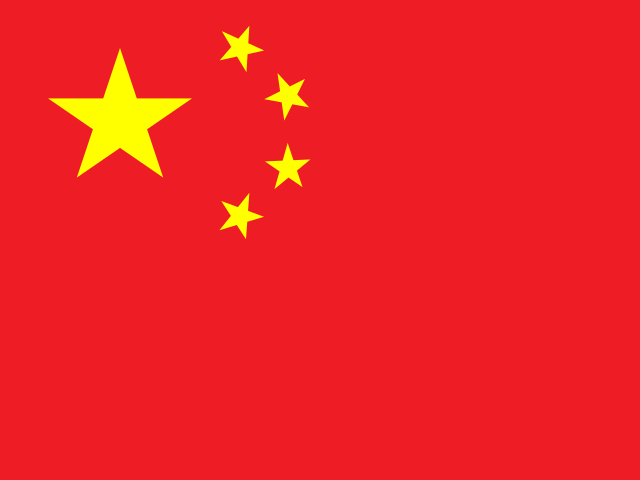
⚠️ Indicators of "trust" and "democratic satisfaction" are not comparable for an authoritarian regime. Sources: V-Dem, Freedom House, RSF, Economist Democracy Index. The table covers governance, not opinion polls.
Data mobilized (data-journalism base)
| Data | Value | Source |
|---|---|---|
| Regime | authoritarian, single party | V-Dem / Freedom House |
| Free national elections | none | Freedom House |
| Press freedom | severely restricted (censorship) | RSF |
| Democracy indices | among the lowest | V-Dem / Economist Democracy Index |
| Trust surveys | biased (not interpretable) ⚠️ | academic analyses |
Sources (national analyses and references)
International governance indices: V-Dem (Varieties of Democracy), Freedom House, Economist Democracy Index, Reporters Without Borders (press freedom) · academic analyses on the biases of opinion surveys under authoritarian rule. No reliable and independent national opinion data.
Methodological note — the synthesis keeps sourced facts distinct from assessments, stays neutral in its presentation of the facts, dates each figure, and does not extrapolate beyond the sources. ⚠️ Major warning: in an authoritarian regime without freedom of expression, trust/satisfaction indicators are structurally biased and are not comparable to those of democracies; this note relies on external governance indices and flags the impossibility of direct comparison. Note generated by AI, human review required. Same safeguards as the rest of the observatory.