
Environment & energy — European Union · Synthesis
A leading player in the climate transition (Green Deal, 2050 neutrality target, carbon market), with steadily falling emissions, but a strong dependence on energy imports revealed by the 2022 shock.
Citoyen synthesis for the Environment and energy category in the European Union. Grounded in the bloc's data (Eurostat, EEA, IEA, Ember). ⚠️ Aggregate of 27 member states with highly different energy mixes. All values are the latest realized observation available — never a forecast. Data last updated: June 2026.
1. State of play — where the transition stands in the EU
Climate leadership. The EU is one of the most advanced players in the climate transition: Green Deal, target of carbon neutrality in 2050, the "Fit for 55" package and a carbon market (ETS, the largest in the world).
Falling emissions. The EU's greenhouse gas emissions have been on a continuous decline since 1990, with moderate per-capita emissions compared to the United States — a decoupling between GDP and emissions.
A rise in renewables. The share of renewables in electricity has risen sharply (wind, solar), now often higher than fossil fuels in the bloc's electricity mix.
Energy dependence revealed. ⚠️ The 2022 shock (halt of Russian gas, cf. Economy and Prices categories) revealed the EU's strong dependence on energy imports, accelerating diversification (LNG, renewables, REPowerEU).
Highly variable mixes. ⚠️ Energy mixes differ widely (nuclear in France, coal in Poland, renewables in Denmark) — the average masks this diversity.
“The EU is at the forefront of the climate transition: Green Deal, 2050 carbon neutrality, carbon market (ETS).”
2. Outlook — where the transition is heading
Meeting the climate targets. Holding the "Fit for 55" trajectory and then 2050 neutrality is the central issue.
Energy security and cost. Reducing dependence on imports while keeping the cost of energy in check (competitiveness, cf. Economy category) is a key trade-off.
A just transition. Supporting the transition (industries, jobs, households) so that it is socially acceptable is an issue (cf. Social cohesion category).
The open questions. Three issues will shape the period: (1) the climate targets; (2) the security and cost of energy; (3) the just transition.
“But the 2022 energy shock revealed its dependence on imports.”
3. International comparison — the EU among the major emitters
Placed in its environment, the EU is a leader of the transition with falling emissions.
Three takeaways. (1) Emissions per capita: moderate and falling. Lower than the United States, higher than India, with a downward trajectory.
(2) An advanced climate framework. The Green Deal and the ETS are the most developed in the world.
(3) Imported dependence. ⚠️ Energy dependence remains a vulnerability, revealed in 2022.
International comparison — environment & energy
| Economy | Emissions/capita | Trend | Specificity |
|---|---|---|---|
| United States | very high | slowly falling | shale gas |
| China | rising ⚠️ | peak targeted | massive renewables |
| India | low | rising | development |
| United Kingdom | moderate | falling sharply | coal phase-out |
| European Union | moderate | falling | Green Deal, ETS |
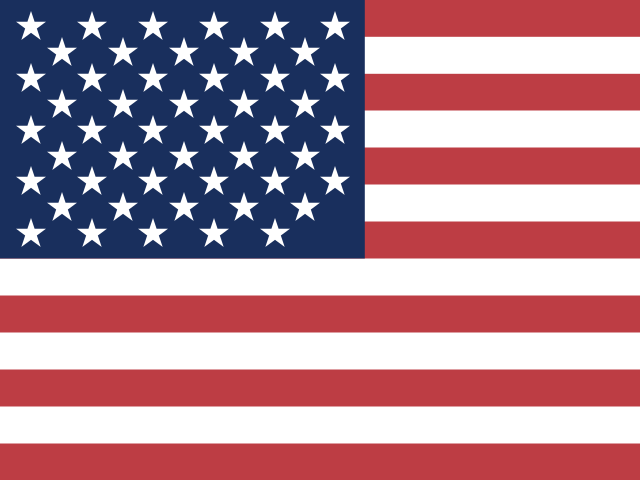
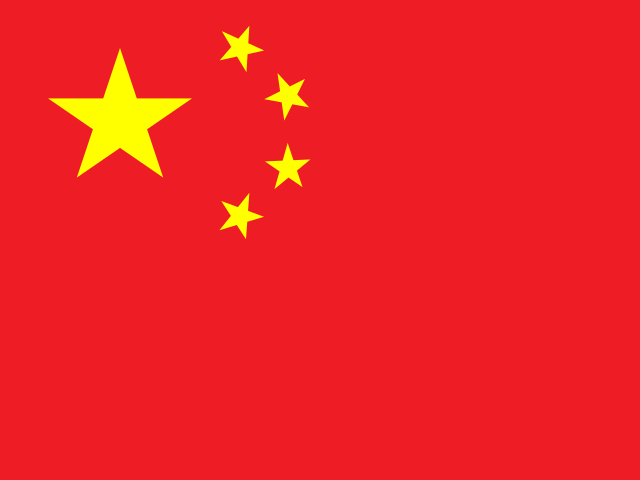
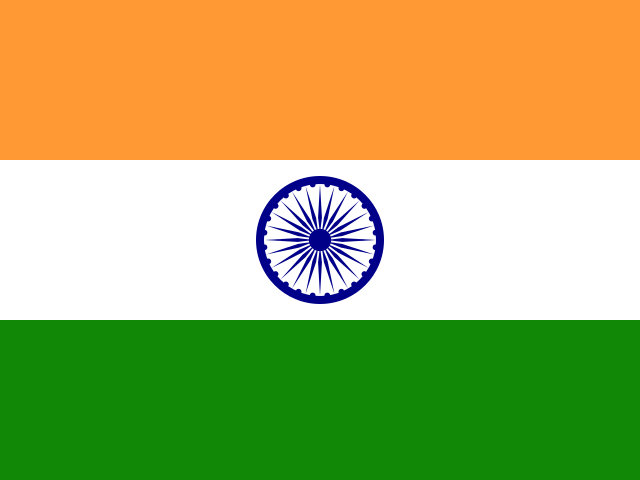
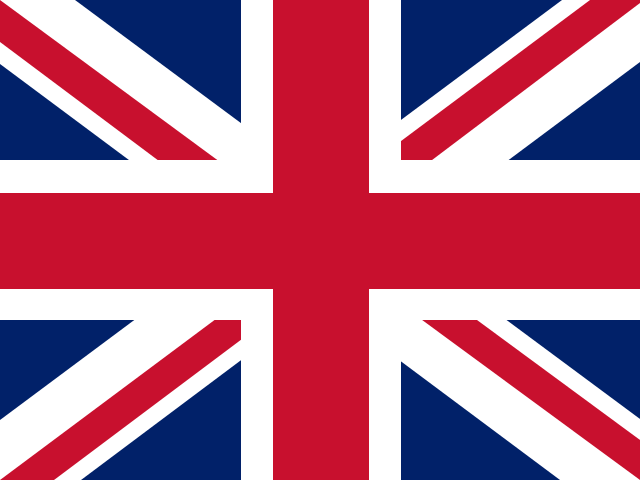
Sources: EEA, IEA, Ember, IPCC — latest realized values available.
Data mobilized (data-journalism base)
| Data | Value | Source |
|---|---|---|
| GHG emissions | falling since 1990 | EEA (Citoyen chart) |
| Target | carbon neutrality 2050 (Fit for 55) | European Commission |
| Carbon market | ETS (the largest) | European Commission |
| Renewables | rising sharply (electricity) | Ember |
| Dependence | ⚠️ imports (2022 shock) | IEA |
Sources (references)
Eurostat · European Environment Agency (EEA) · IEA · Ember · IPCC.
Methodological note — the synthesis keeps sourced facts distinct from assessments, stays neutral, dates each figure, and does not extrapolate beyond the sources. ⚠️ Aggregate of 27 member states with highly different energy mixes. Latest realized observation available (no forecast). Note generated by AI, human review required.