
Social cohesion — India · Synthesis
A historic decline in extreme poverty, but sharply rising income and wealth inequalities, and persistent divides of caste, gender and region.
Citoyen synthesis for the Social cohesion and inequalities category in India. Grounded in sector data (NSO, NITI Aayog, World Bank, World Inequality Lab). All values are the last available realised observation — never a forecast. Assessments are distinguished from sourced facts. Data last updated: June 2026.
1. Current situation — where does social cohesion stand
A historic decline in extreme poverty. Thanks to growth and social programmes, India has lifted hundreds of millions of people out of extreme poverty over recent decades (World Bank) — one of the largest reductions in the world, even though poverty remains widespread.
Sharply rising inequalities. Income and especially wealth inequalities have risen sharply (World Inequality Lab): the concentration of wealth at the top has become very high, among the most pronounced in the world — an "extreme inequality" according to some studies.
The caste divide. The caste system, although illegal as a form of discrimination, continues to structure social, economic and access inequalities (education, employment). Affirmative action policies ("reservations") aim to correct these gaps.
Strong gender inequalities. Gender inequalities are significant: low female labour market participation (see Labour category), gaps in education and health, sex-ratio imbalances in some regions.
Regional inequalities. Gaps between States (South and West more developed, some northern States poorer) are considerable, shaping development and internal migration (see Immigration category).
“India has lifted hundreds of millions of people out of extreme poverty — a major achievement.”
2. Outlook — where is social cohesion heading
Continuing the decline in poverty. Continuing to reduce poverty through inclusive growth, employment (see Labour category) and social programmes is a central challenge.
Containing inequalities. Curbing the sharp rise in income and wealth inequalities through taxation, education (see Education category) and employment is a cohesion challenge.
Reducing caste and gender divides. Combating caste and gender discrimination and improving women's participation are equity and growth challenges.
Territorial cohesion. Reducing gaps between States is a development and national cohesion challenge.
Open questions. Three challenges will shape the period ahead: (1) continuing the decline in poverty; (2) containing inequalities; (3) reducing divides of caste, gender and region.
“But income and especially wealth inequalities have risen sharply, and caste and gender divides persist.”
3. International comparison — India among its peers
Placed in context, India combines a decline in poverty with a sharp rise in inequalities, along with specific divides (caste, gender).
Three takeaways. (1) Poverty: a major decline. Like China, India has significantly reduced extreme poverty — a large-scale achievement.
(2) Inequalities: sharply rising. India's wealth inequalities have become very high, among the most pronounced in the world according to the World Inequality Lab.
(3) Specific divides. Caste and gender inequalities are dimensions specific to India, with no direct equivalent elsewhere.
International comparison — inequalities
| Country | Inequalities | Poverty | Specific divide |
|---|---|---|---|
| China | high (Gini ≈ 0.47) ⚠️ | historic decline | urban-rural (hukou) |
| Brazil | very high (Gini ≈ 0.52) | declining | racial |
| Indonesia | moderate-high | declining | regional |
| South Africa | extreme (Gini ≈ 0.63) | high | racial |
| India | very high (wealth) | decline in extreme poverty | caste, gender |

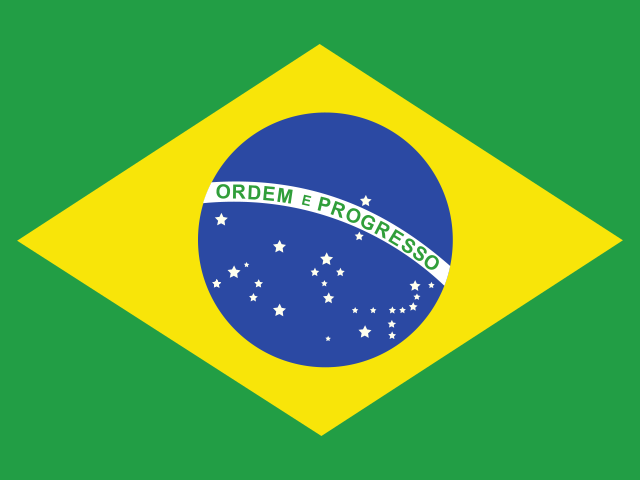
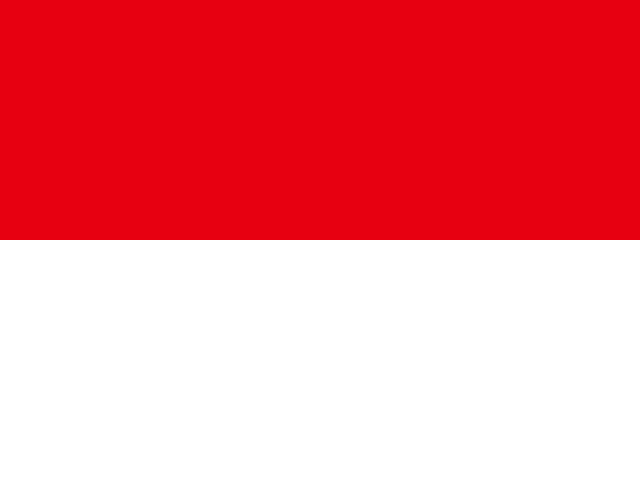
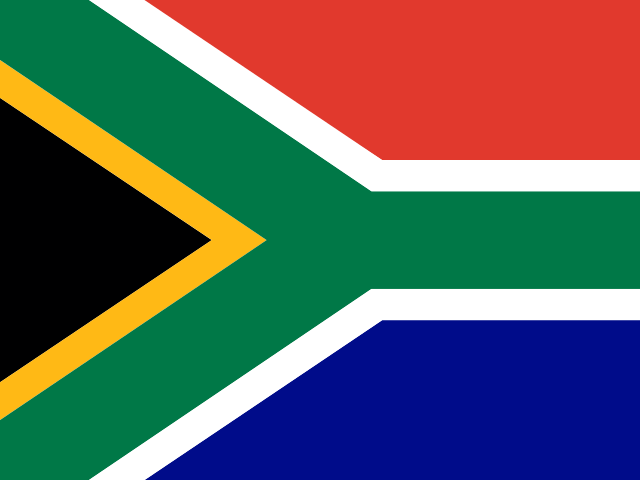
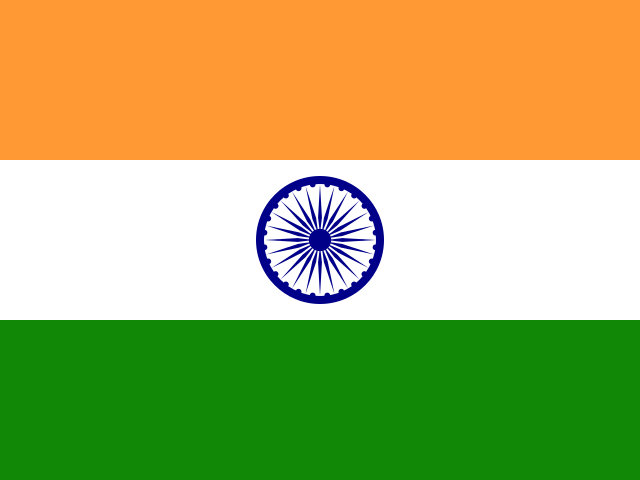
Sources: World Bank, World Inequality Lab, NSO. Inequality measures vary (income, consumption, wealth); comparisons should be treated with caution. "≈" denotes rounding.
Data mobilized (data-journalism base)
| Data | Value | Source |
|---|---|---|
| Decline in extreme poverty | hundreds of millions lifted | World Bank |
| Wealth inequalities | very high (rising) | World Inequality Lab |
| Caste divide | persistent | NSO / studies |
| Gender inequalities | strong | NSO / World Bank |
| Regional inequalities | strong (between States) | NITI Aayog |
Sources (national analyses and references)
NSO (consumption, incomes) · NITI Aayog (multidimensional poverty index) · World Bank (poverty) · World Inequality Lab (income and wealth inequalities).
Methodology note — the synthesis distinguishes sourced facts from assessments, remains neutral, dates each data point, and does not extrapolate beyond sources. Inequality measures (income, consumption, wealth) differ; comparisons should be treated with caution. All values are the last available realised observation (no forecast). Note generated by AI, human review required. Same safeguards as the rest of the observatory.