
Defence — Japan · Synthesis
A historic turning point: long constrained by its pacifist Constitution, Japan is doubling its defence effort to bring it to 2% of GDP by 2027, in response to China's rise and North Korean threats.
Citoyen synthesis for the Defence category in Japan. Grounded in sector data (Ministry of Defence, SIPRI, IISS). All values are the latest available recorded observation — never a forecast. Assessments are distinguished from sourced facts. Data last updated: June 2026.
1. Current state — where Japanese defence stands
A historic turning point. Long limited by Article 9 of its pacifist Constitution and a spending norm of around 1% of GDP, Japan has embarked on its largest military build-up since 1945: the national security strategy (2022) plans to bring the defence effort to 2% of GDP by 2027, a near-doubling.
A sharply rising budget. Military spending is increasing strongly (in the order of 50 billion dollars and beyond, SIPRI), making Japan one of the world's largest military budgets. The country is notably acquiring 'counter-attack' strike capabilities (long-range missiles), a doctrinal shift.
Self-Defence Forces. Japan has modern and well-equipped Self-Defence Forces ('Jieitai') (≈ 250,000 personnel), with a defensive vocation. Their status and deployment remain governed by the Constitution, a recurring subject of political debate.
Under the American security umbrella. Japan has no nuclear weapons and relies on its alliance with the United States (security treaty, American bases, extended deterrence), the cornerstone of its defence. Japan's reinforcement complements this alliance.
A tense regional environment. The rearmament responds to a deteriorating regional environment: the military rise of China (Taiwan, South China Sea), North Korea's nuclear and ballistic programmes, and territorial tensions — all justifying the strategic shift.
“Japan has embarked on its largest military build-up since 1945, targeting 2% of GDP by 2027 — a change of era.”
2. Outlook — where defence is heading
Reaching 2% of GDP. The ramp-up to 2% of GDP by 2027 and its financing (debated tax increases) are the central trade-off, in a context of record debt (see Economy category).
Counter-attack capabilities. The acquisition of long-range strike capabilities marks a major doctrinal shift, debated in light of the pacifist Constitution and public opinion.
American alliance and cooperation. Deepening the alliance with the United States and regional cooperation (with South Korea, Australia, within the Indo-Pacific framework) shapes the strategy vis-à-vis China.
Defence industry. The development and export of Japan's defence industry (easing of export rules, GCAP combat aircraft programme with the United Kingdom and Italy) is a new axis.
Open questions. Three trade-offs will shape the period: (1) financing the increase towards 2% of GDP; (2) accommodating counter-attack capabilities within the Constitution; (3) deepening the alliance and regional cooperation.
“Constitutionally pacifist and dependent on the American security umbrella, Japan is rearming in the face of China and North Korea.”
3. International comparison — Japan among the military powers
Placed in its context, Japan is undertaking a historic rearmament, becoming one of the world's largest military budgets, while remaining non-nuclear and dependent on the American ally.
Three findings. (1) A sharply rising budget. Japan is joining the ranks of the largest budgets, at a level comparable to or exceeding France and Germany depending on the year, but far behind the United States (≈ 900-970 bn$) and China (≈ 300-340 bn$).
(2) No nuclear weapons. Like Germany, Japan has no nuclear weapons and depends on American extended deterrence — a strategic constraint governed by its Constitution.
(3) A doctrinal shift. The move from a strictly defensive posture to the acquisition of counter-attack capabilities is a rupture, driven by the rise of China — a shift comparable in its relative scale to the German 'Zeitenwende'.
International comparison — defence efforts
| Country | Budget (~bn$) | % GDP | Nuclear deterrence |
|---|---|---|---|
| United States | ≈ 900-970 | ≈ 3.4% | ✓ |
| China | ≈ 300-340 | ≈ 1.5% | ✓ |
| France | ≈ 60-67 | ≈ 2.0% | ✓ |
| South Korea | ≈ 48 | ≈ 2.7% | ✗ |
| Germany | ≈ 90-114 | ≈ 2.1% | ✗ |
| Japan | ≈ 50+ | towards 2% (2027) | ✗ |



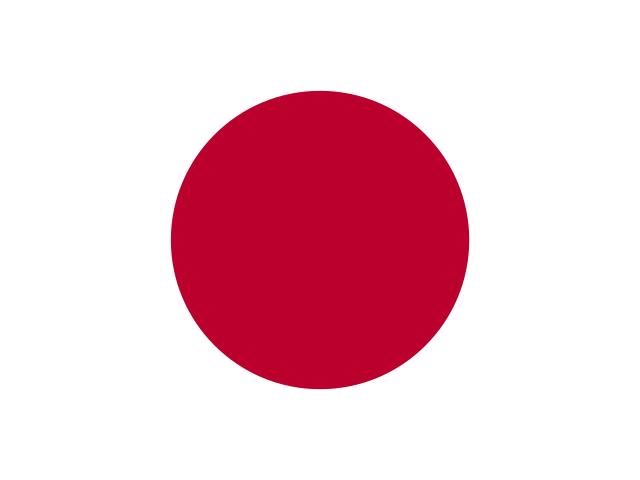
Sources: SIPRI & IISS (budgets) — latest available recorded values. Ranges reflect differences in scope and year; the Japanese budget is rising sharply. "≈" indicates rounding.
Data used (data journalism base)
| Data | Value | Source |
|---|---|---|
| Military spending | ≈ 50 bn$ and rising | SIPRI (Citoyen chart) |
| Target | 2% of GDP by 2027 | Ministry of Defence |
| Personnel (Self-Defence Forces) | ≈ 250,000 | Min. Defence / IISS (Citoyen chart) |
| Nuclear deterrence | none (US alliance) | IISS |
| Doctrinal shift | counter-attack capabilities | 2022 National Security Strategy |
Sources (national analyses and references)
Ministry of Defence (budget, 2022 national security strategy, Self-Defence Forces) · Diet (committees) · SIPRI (Military Expenditure) · IISS (Military Balance).
Methodology note — the synthesis distinguishes sourced facts from assessments, remains neutral, dates each data point, and does not extrapolate beyond sources. Budgets vary by scope and year (ranges); the Japanese increase is ongoing. All values are the latest available recorded observation (no forecasts). Note AI-generated, human review required. Same safeguards as the rest of the observatory.