
Defence — South Korea · Synthesis
A high defence effort facing the North Korean threat, a large conscript army, and a defence industry that has become a major global arms exporter — under the American nuclear umbrella.
Citoyen synthesis for the Defence category in South Korea. Grounded in the sector's quantitative data (Ministry of National Defense, SIPRI, IISS). All values are the latest realized observation available — never a forecast. Assessments are kept distinct from sourced facts. Data last updated: June 2026.
1. State of play — where South Korean defence stands
A high defence effort. South Korean military spending amounts to around approximately $48 billion (≈ 2.7% of GDP, SIPRI), one of the highest efforts among democracies, justified by the permanent threat of North Korea (nuclear and ballistic programmes).
A large conscript army. South Korea maintains compulsory military service and a large army (significant active-duty personnel, large reserves), facing a massive North Korean military. The declining demographics (see Economy category) are, however, posing a growing challenge for recruitment.
An arms-exporting defence industry. The South Korean defence industry has become a major global arms exporter (K2 tanks, K9 howitzers, FA-50 aircraft, for example), with record contracts, notably in Europe (Poland) — a remarkable rise in power (see Economy category).
Under the American nuclear umbrella. South Korea does not possess nuclear weapons and relies on the alliance with the United States (US troops stationed, extended deterrence). The debate about a possible indigenous nuclear deterrent resurfaces periodically in the face of the North Korean threat.
A growing North Korean threat. The advances in Pyongyang's nuclear and ballistic programmes and the North Korea–Russia rapprochement are worsening the security environment — the central determinant of South Korean defence.
“Facing North Korea, the South maintains one of the highest defence efforts among democracies (≈ 2.7% of GDP).”
2. Outlook — where defence is heading
Facing North Korea. The evolution of the North Korean threat (nuclear, missiles, Russian support) is the main driver of South Korean defence policy.
Deterrence debate. The debate about an indigenous nuclear deterrent or enhanced nuclear-sharing with the United States resurfaces in a context of uncertainty about US commitment.
Defence industry. The continued rise of arms exports is a major industrial and strategic axis.
Demographics and conscription. The demographic decline undermines the large-conscript model, pushing towards professionalisation and technology.
The open questions. Three trade-offs will shape the period: (1) responding to the North Korean threat; (2) settling the deterrence debate; (3) adapting the conscription model to demographic decline.
“The South Korean defence industry has become a leading global arms exporter (tanks, howitzers, aircraft).”
3. International comparison — South Korea among military powers
Placed in its environment, South Korea has a high defence effort facing an existential threat, and a booming defence industry — under American nuclear cover.
Three takeaways. (1) High relative effort. At ≈ 2.7% of GDP, South Korea's effort exceeds France (≈ 2.0%), Germany and Japan — one of the highest among democracies, justified by the North Korean threat.
(2) Non-nuclear, dependent on the United States. Like Japan, South Korea does not have nuclear weapons and depends on the American ally — hence the recurring debate on deterrence.
(3) A rising exporter. The South Korean defence industry has become a global player, competing with established suppliers across several segments.
International comparison — defence efforts
| Country | Budget (≈ $bn) | % GDP | Nuclear deterrence |
|---|---|---|---|
| United States | ≈ 900–970 | ≈ 3.4% | ✓ |
| China | ≈ 300–340 ⚠️ | ≈ 1.5% | ✓ |
| Russia | ≈ 130–150 | ≈ 6–7% | ✓ |
| Japan | ≈ 50+ | towards 2% | ✗ |
| France | ≈ 60–67 | ≈ 2.0% | ✓ |
| South Korea | ≈ 48 | ≈ 2.7% | ✗ |

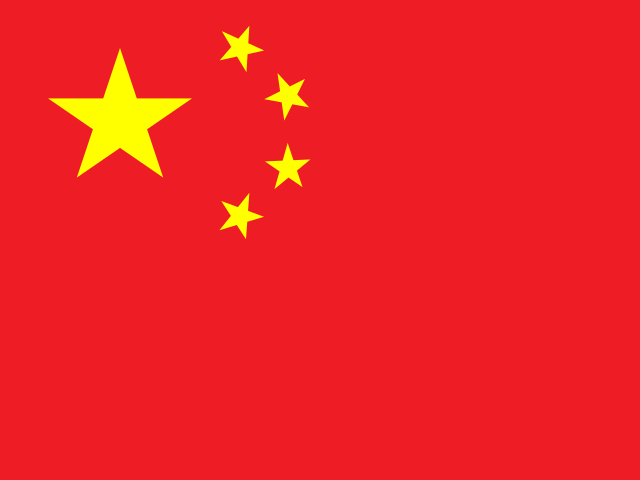
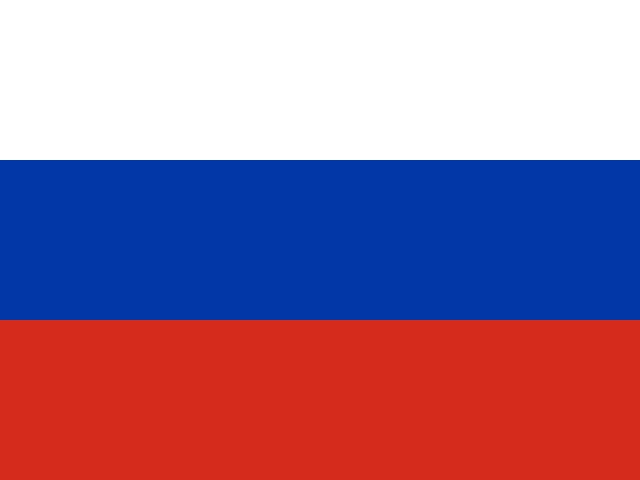
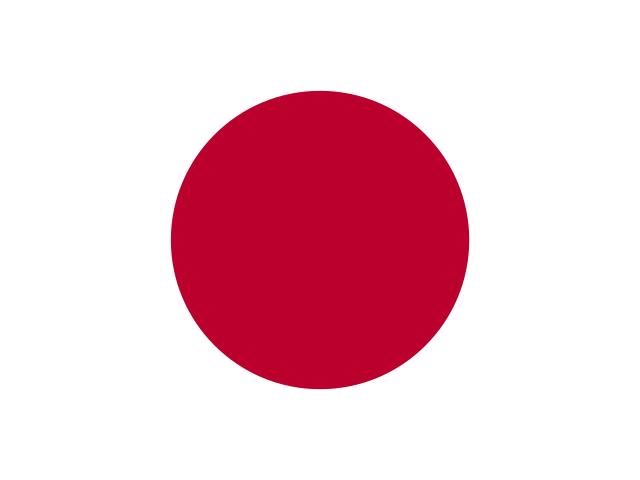
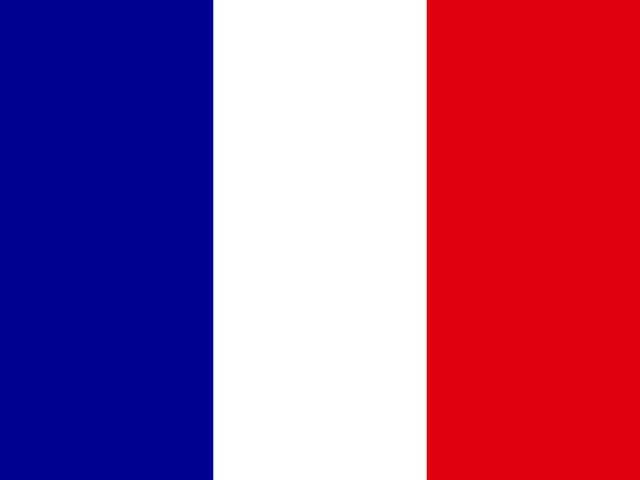
Sources: SIPRI & IISS (budgets) — latest realized values available. Ranges reflect differences in scope and year. "≈" denotes a rounding.
Data mobilized (data-journalism base)
| Data | Value | Source |
|---|---|---|
| Military spending | ≈ $48 billion | SIPRI (Citoyen chart) |
| Share of GDP | ≈ 2.7% | SIPRI / NATO (Citoyen chart) |
| Military service | compulsory (conscription) | Ministry of National Defense |
| Nuclear deterrence | none (US alliance) | IISS |
| Defence industry | major global arms exporter | SIPRI Arms Transfers |
Sources (national analyses and references)
Ministry of National Defense (budget, posture, conscription) · SIPRI (Military Expenditure & Arms Transfers) · IISS (Military Balance).
Methodological note — the synthesis keeps sourced facts distinct from assessments, stays neutral, dates each figure, and does not extrapolate beyond the sources. Budgets vary according to scope and year (ranges). All values are the latest realized observation available (no forecast). Note generated by AI, human review required. Same safeguards as the rest of the observatory.