
Defence — Mexico · Synthesis
A low defence effort, but armed forces with a growing internal role — security against the cartels, but also infrastructure management and customs — making them a major economic and political actor.
Citoyen synthesis for the Defence category in Mexico. Grounded in the sector's quantitative data (SEDENA, SEMAR, SIPRI, IISS). All values are the latest realized observation available — never a forecast. Assessments are kept distinct from sourced facts. Data last updated: June 2026.
1. State of play — where Mexican defence stands
A low defence effort. Mexican military spending is modest (of the order of 12 to 15 billion dollars, around 0.7% of GDP, SIPRI) — one of the lowest defence efforts among major countries, as Mexico faces no major external threat.
A growing internal role. The armed forces (SEDENA for the army, SEMAR for the navy) have seen their internal role greatly extended: public security against the cartels (see the Security category), notably through the National Guard, but also management of infrastructure (airports, Maya Train), customs and programmes — a major economic and political actor.
A militarization of security. The use of the army for public security, in the absence of effective civilian police forces and in the face of impunity (see the Justice category), is a long-term strategy, debated on grounds of effectiveness and its effects on rights and civilian oversight.
No nuclear deterrence. Mexico has no nuclear weapons and no external projection posture; its defence is oriented towards the territory and internal security.
Cooperation with the United States. Security cooperation with the United States (combating cartels, drug and weapons trafficking) is a major axis, diplomatically sensitive.
“The Mexican army devotes a modest budget, but its internal role has extended greatly, well beyond defence.”
2. Outlook — where defence is heading
The army's role in security. The scale and permanence of the army's internal role (security, economy) is a major democratic and civilian-oversight issue.
Effectiveness against the cartels. The effectiveness of the militarized strategy against the cartels and violence (see the Security category) is debated.
Bilateral cooperation. Cooperation with the United States (drugs, weapons, fentanyl) is decisive and under diplomatic tension.
Civilian oversight. Maintaining civilian control over armed forces with an extended economic and security role is an institutional challenge.
The open questions. Three issues will shape the period: (1) framing the internal role of the army; (2) assessing effectiveness against the cartels; (3) preserving civilian oversight.
“Security against the cartels, but also airports, trains, customs: the army has become a central economic actor.”
3. International comparison — Mexico among military powers
Placed in its environment, Mexico has a low defence effort but an army with an exceptionally extended internal role.
Three takeaways. (1) Very low effort. At ≈ 0.7% of GDP, Mexico's effort is one of the lowest, below Brazil (≈ 1.1%) and well below France (≈ 2%).
(2) A singular internal role. The extension of the army's role to public security and the economy is more marked than in most comparable countries.
(3) No external posture. Like Brazil, Mexico has no nuclear capability or external projection; its defence is internal.
International comparison — defence efforts
| Country | Budget (~bn$) | % GDP | Dominant role |
|---|---|---|---|
| United States | ≈ 900–970 | ≈ 3.4% | global projection |
| Brazil | ≈ 20–30 | ≈ 1.1% | regional / internal |
| France | ≈ 60–67 | ≈ 2.0% | projection / deterrence |
| Argentina | ≈ 3–4 | ≈ 0.5% | territorial |
| Mexico | ≈ 12–15 | ≈ 0.7% | internal (security, economy) |

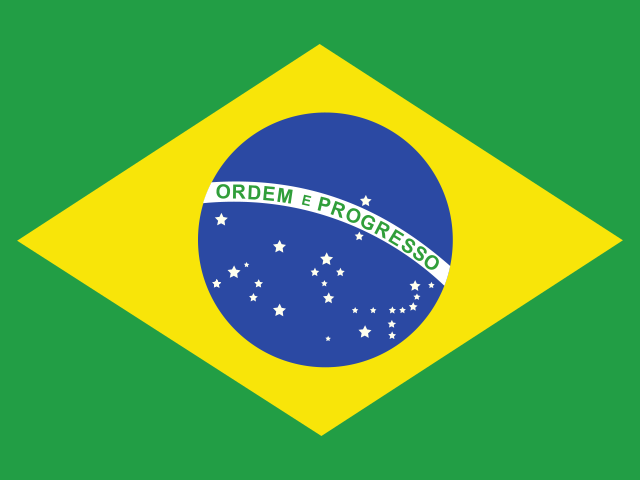


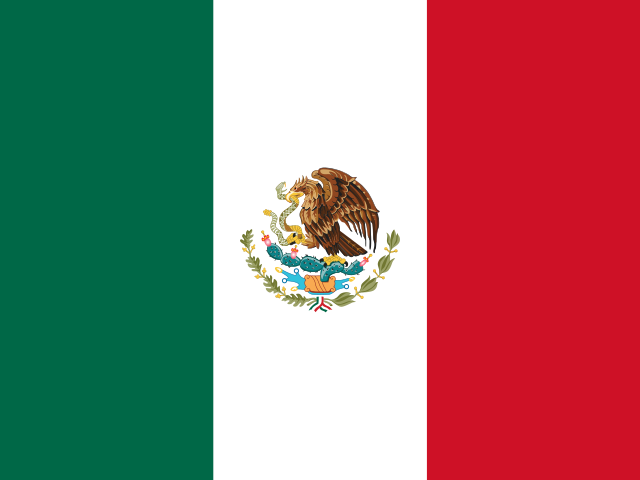
Sources: SIPRI & IISS (budgets) — latest realized values available. "≈" denotes a rounding.
Data mobilized (data-journalism base)
| Data | Value | Source |
|---|---|---|
| Military spending | ≈ 12–15 bn$ | SIPRI (Citoyen chart) |
| Share of GDP | ≈ 0.7% (low) | SIPRI (Citoyen chart) |
| Internal role | security + infrastructure + customs | SEDENA / SEMAR |
| National Guard | militarized | SEDENA |
| Nuclear deterrence | none | IISS |
Sources (national analyses and references)
SEDENA (army and air force) · SEMAR (navy) · SIPRI (Military Expenditure) · IISS (Military Balance).
Methodological note — the synthesis keeps sourced facts distinct from assessments, stays neutral, dates each figure, and does not extrapolate beyond the sources. All values are the latest realized observation available (no forecast). Note generated by AI, human review required. Same safeguards as the rest of the observatory.