
Environment & energy — Mexico · Synthesis
A major Latin American emitter dependent on hydrocarbons, where the State has relaunched oil (Pemex) at the expense of renewables — with marked urban pollution and vast untapped solar potential.
Citoyen synthesis for the Environment and climate category in Mexico. Grounded in the sector's quantitative data (INECC, SEMARNAT, IEA, OWID). All values are the latest realized observation available — never a forecast. Assessments are kept distinct from sourced facts. Data last updated: June 2026.
1. State of play — where Mexico stands on climate
A major Latin American emitter. Mexico's greenhouse gas emissions are of the order of 700 MtCO2e, among the highest in Latin America, dominated by energy (hydrocarbons) and transport (see the Transport category).
Hydrocarbon dependence. Mexico is an oil producer (state company Pemex). Recent energy policy has relaunched oil and public electricity (CFE), at the expense of private renewable deployment — a debated strategic choice.
Untapped renewable potential. Mexico has strong solar and wind potential (sunshine, winds), still largely unexploited due to political choices favouring public and fossil energy — a lag on the transition.
Marked urban pollution. Air quality in major cities (Mexico City, at altitude) is a recurrent public-health issue (see the Health category).
Climate exposure. Mexico is exposed to climate risks: droughts, water stress (particularly in the North and Mexico City), hurricanes, heatwaves — growing risks.
“Mexico has chosen to relaunch oil and public electricity, slowing the deployment of renewables.”
2. Outlook — where the transition is heading
Renewables vs hydrocarbons. The trade-off between relaunching public hydrocarbons and deploying renewables, where potential is strong, is the central energy and climate policy issue.
Decarbonizing energy and transport. Reducing emissions from energy and transport is necessary for climate objectives, in a country dependent on fossil fuels.
Water stress. Water management, under severe strain (North, Mexico City), is a major adaptation and development challenge.
Air pollution. Improving urban air quality is a public-health issue.
The open questions. Three issues will shape the decade: (1) arbitrating between hydrocarbons and renewables; (2) managing water stress; (3) reducing air pollution.
“Endowed with strong solar and wind potential, the country still exploits little of this resource.”
3. International comparison — Mexico among the major emitters
Placed in its environment, Mexico is a hydrocarbon-dependent emitter, with a renewable transition slowed by political choices.
Three takeaways. (1) Volume: moderate. At ≈ 700 Mt, Mexico's emissions are close to Germany's, well below the United States or China.
(2) Renewables: lagging. Unlike Brazil (hydropower) or countries betting on solar, Mexico exploits little of its strong renewable potential.
(3) A fossil choice. The relaunch of public hydrocarbons sets Mexico apart from the international trend towards renewables — a debated bet.
International comparison — emissions
| Country | GHG emissions (MtCO2e) | Renewables | Energy choice |
|---|---|---|---|
| China | ≈ 12,000+ | rising | coal + renewables |
| United States | ≈ 5,500–6,000 | ≈ 21–23% | gas + renewables |
| European Union | ≈ 3,000–3,200 | high | regulatory |
| Brazil | ≈ 1,000+ | very high (hydro) | hydropower |
| Mexico | ≈ 700 | little exploited | hydrocarbons (relaunch) |
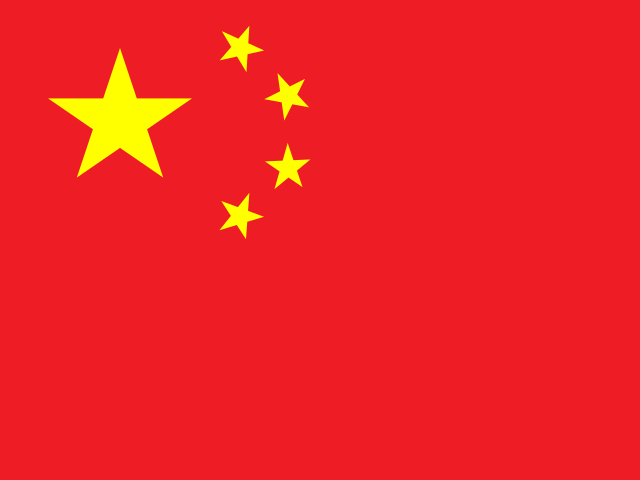


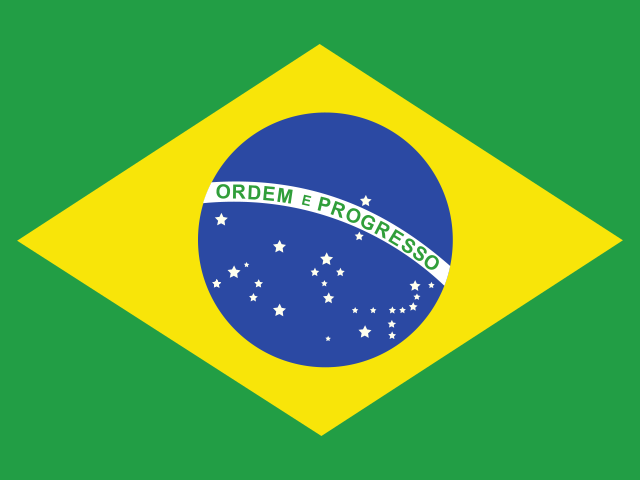
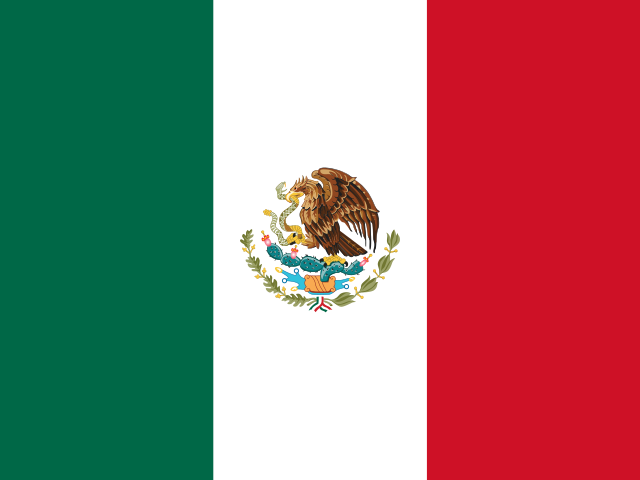
Sources: INECC, IEA, OWID — territorial emissions, latest realized values. China and the United States appear for scale. "≈" denotes a rounding.
Data mobilized (data-journalism base)
| Data | Value | Source |
|---|---|---|
| GHG emissions | ≈ 700 MtCO2e | INECC / OWID (Citoyen chart) |
| Energy | hydrocarbon dependence (Pemex) | IEA / SEMARNAT |
| Renewables | strong potential, little exploited | IEA (Citoyen chart) |
| Air pollution | marked (Mexico City) | INECC (Citoyen chart) |
| Water stress | high (North, Mexico City) | CONAGUA |
Sources (national analyses and references)
INECC (National Institute of Ecology and Climate Change — emissions inventory) · SEMARNAT (Ministry of the Environment) · CONAGUA (water) · IEA · Our World in Data.
Methodological note — the synthesis keeps sourced facts distinct from assessments, stays neutral, dates each figure, and does not extrapolate beyond the sources. Territorial emissions are used. China and the United States appear for scale. All values are the latest realized observation available (no forecast). Note generated by AI, human review required. Same safeguards as the rest of the observatory.