
Social cohesion — Mexico · Synthesis
High inequalities and widespread poverty, recently receding thanks to remittances and social programmes, with a marked North–South divide and a disadvantage for indigenous populations.
Citoyen synthesis for the Social cohesion and inequalities category in Mexico. Grounded in the sector's quantitative data (INEGI, CONEVAL, World Bank, OECD). All values are the latest realized observation available — never a forecast. Assessments are kept distinct from sourced facts. Data last updated: June 2026.
1. State of play — where social cohesion stands
High inequalities. Mexico's Gini index is high (of the order of 0.42–0.45, World Bank), reflecting marked income and wealth inequalities, even if below Brazil or South Africa.
Widespread poverty, recently receding. Poverty (measured in a multidimensional way by CONEVAL) remains widespread, but has receded over the recent period — supported by remittances (see the Economy category), the sharp minimum-wage increase (see the Labour category) and social programmes (direct transfers).
A North–South divide. The gaps between the North (industrial, integrated with the United States, wealthier) and the South (Chiapas, Oaxaca, Guerrero, poorer and more rural) are marked, structuring inequalities and internal migration.
A disadvantage for indigenous populations. Indigenous populations face income, education (see the Education category), health and service-access gaps — an important dimension of inequalities, concentrated in the South.
Informality and insecurity. Massive informality (see the Labour category) and insecurity (see the Security category) weigh heavily on social cohesion and living conditions.
“Poverty has recently receded, supported by remittances, the minimum-wage increase and social transfers.”
2. Outlook — where social cohesion is heading
Making the poverty reduction sustainable. Maintaining the poverty reduction, via transfers, the minimum wage, remittances and formal employment (see the Labour and Economy categories), is the central challenge.
Reducing the North–South divide. Developing the South (infrastructure, jobs, services) is a territorial cohesion issue.
Including indigenous populations. Reducing the disadvantage of indigenous populations is an equity issue.
Formalization and protection. Extending social protection, in a very informal economy, is a cohesion lever.
The open questions. Three issues will shape the period: (1) making poverty reduction sustainable; (2) reducing the North–South divide; (3) including indigenous populations.
“The divide between the industrial North and the poor South, and the disadvantage of indigenous populations, structure inequalities.”
3. International comparison — Mexico among its peers
Placed in its environment, Mexico has high inequalities but receding poverty, with territorial and ethnic divides.
Three takeaways. (1) Inequalities: high. With a Gini of ≈ 0.42–0.45, Mexico is more unequal than the United States, below Brazil (≈ 0.52) and South Africa.
(2) A recent poverty reduction. Supported by remittances, the minimum wage and transfers — a recent distinctive factor.
(3) North–South and indigenous divides. These territorial and ethnic dimensions are marked, shared with other emerging economies.
International comparison — inequalities
| Country | Gini | Poverty | Specificity |
|---|---|---|---|
| France | ≈ 0.29 | low | strong redistribution |
| United States | ≈ 0.39–0.41 | high | strong inequalities |
| Brazil | ≈ 0.52 | receding | racial |
| South Africa | ≈ 0.63 | very high | racial |
| Mexico | ≈ 0.42–0.45 | recently receding | North–South, indigenous |


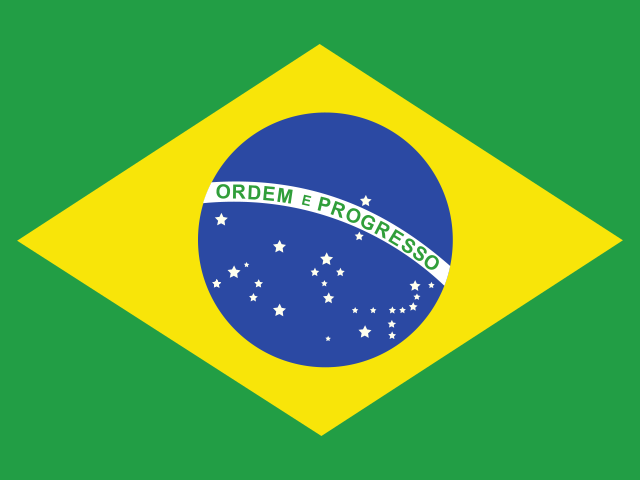
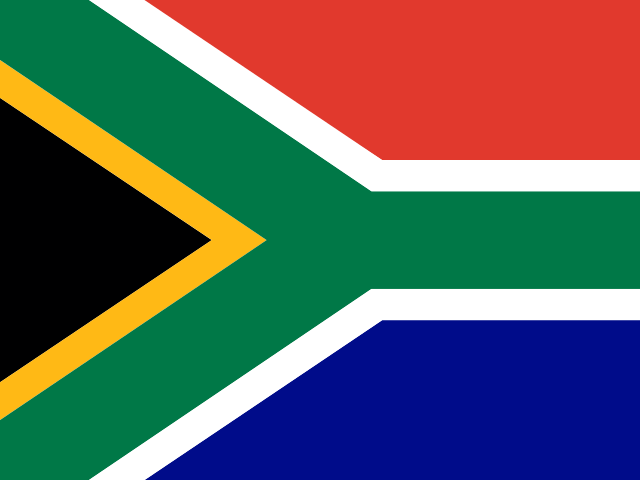
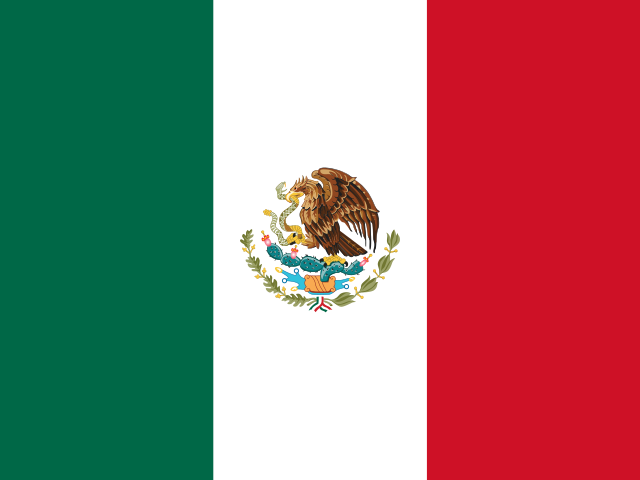
Sources: World Bank (Gini), INEGI, CONEVAL, OECD. Definitions vary; comparisons with caution. "≈" denotes a rounding.
Data mobilized (data-journalism base)
| Data | Value | Source |
|---|---|---|
| Gini index | ≈ 0.42–0.45 | World Bank / INEGI (Citoyen chart) |
| Poverty (multidimensional) | widespread, recently receding | CONEVAL (Citoyen chart) |
| Factors behind recession | remittances, minimum wage, transfers | CONEVAL / Banco de México |
| North–South divide | marked | INEGI |
| Indigenous disadvantage | strong (South) | INEGI / CONEVAL |
Sources (national analyses and references)
INEGI (income, inequalities) · CONEVAL (multidimensional poverty measurement) · Banco de México (remittances) · World Bank · OECD.
Methodological note — the synthesis keeps sourced facts distinct from assessments, stays neutral, dates each figure, and does not extrapolate beyond the sources. Mexican poverty is measured in a multidimensional way (CONEVAL). All values are the latest realized observation available (no forecast). Note generated by AI, human review required. Same safeguards as the rest of the observatory.