
Education — Türkiye · Synthesis
A major expansion of schooling and higher education, PISA results improving but below the OECD average, and debates about quality, inequality and the role of religion in schools.
Citoyen synthesis for the Education category in Türkiye. Grounded in the sector's quantitative data (MEB, TÜİK, OECD, UNESCO). All values are the latest realized observation available — never a forecast. Assessments are kept distinct from sourced facts. Data last updated: June 2026.
1. State of play — where the Turkish education system stands
A massive expansion. Türkiye has massively expanded its schooling and higher education in a single generation, driven by young demographics — a considerable educational effort.
PISA results improving but below the average. In PISA (OECD), Türkiye achieves results that are improving but below the OECD average, reflecting uneven quality despite the expansion.
Large inequalities. Results vary sharply by region (rural East vs urban West), income and gender — inequalities in access and quality are a central challenge.
A debate on religion. The place of religious education (İmam Hatip schools) and the orientation of curricula are a subject of social debate.
An expanding higher education. The number of universities and students has grown strongly; quality and fit with the economy's needs are key challenges.
“Türkiye has massively expanded its schooling and higher education in a single generation.”
2. Outlook — where the system is heading
Improving quality. Converting the quantitative expansion into quality (PISA results) is the central challenge.
Reducing inequalities. Closing regional and gender gaps is an equity challenge.
Skills and the economy. Linking education and higher education to the economy's needs (industry, technology) is a development lever.
The open questions. Three issues will shape the period: (1) improving quality; (2) reducing inequalities; (3) adapting skills to the economy.
“PISA results are improving but remain below the OECD average, with large inequalities.”
3. International comparison — Türkiye among its peers
Placed in its environment, Türkiye has a system that is rapidly expanding but with results to consolidate.
Three takeaways. (1) PISA: below OECD average, improving. Türkiye outperforms Brazil and Mexico, but remains below the EU and Germany.
(2) A remarkable expansion. The extension of schooling and higher education distinguishes the Turkish trajectory.
(3) Persistent inequalities. As in emerging economies, regional and gender gaps carry significant weight.
International comparison — education
| Country | PISA maths (2022) | Schooling | Inequalities |
|---|---|---|---|
| Germany | ≈ 475 | high | moderate |
| European Union | ≈ 472 (OECD avg) | high | variable |
| Mexico | ≈ 395 | rising | large |
| Brazil | ≈ 379 | rising | large |
| Türkiye | ≈ 453 | major expansion | large regional |


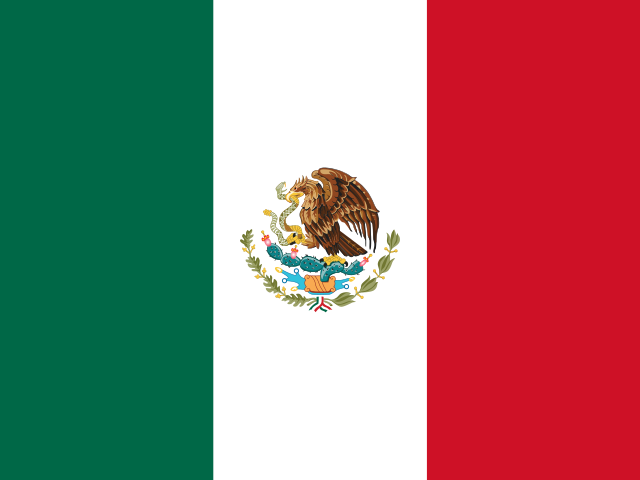
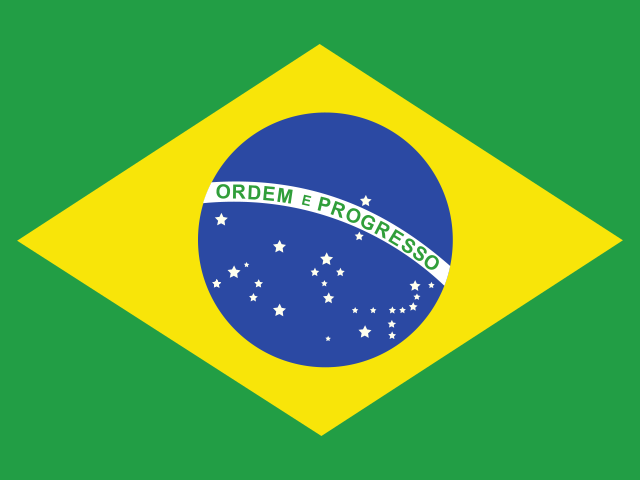
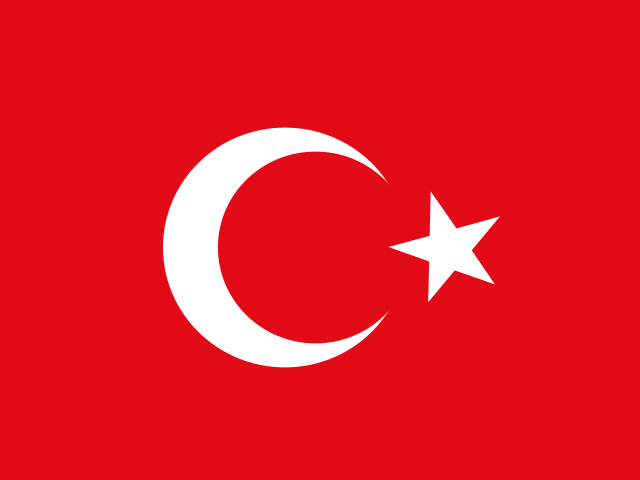
Sources: OECD (PISA 2022), UNESCO, MEB. "≈" denotes a rounding.
Data mobilized (data-journalism base)
| Data | Value | Source |
|---|---|---|
| PISA score | below OECD average (improving) | OECD PISA (Citoyen chart) |
| Schooling | major expansion | MEB / UNESCO |
| Higher education | strongly growing | MEB |
| Inequalities | regional, by gender | TÜİK |
| Debates | role of religion | analyses |
Sources (national analyses and references)
Ministry of Education (MEB) · TÜİK · OECD (PISA 2022) · UNESCO.
Methodological note — the synthesis keeps sourced facts distinct from assessments, stays neutral, dates each figure, and does not extrapolate beyond the sources. All values are the latest realized observation available (no forecast). Note generated by AI, human review required. Same safeguards as the rest of the observatory.