
Health — Türkiye · Synthesis
A health reform ("Health Transformation") that has greatly extended coverage and improved life expectancy, with still-moderate health spending and persistent disparities.
Citoyen synthesis for the Health category in Türkiye. Grounded in the sector's quantitative data (Ministry of Health, TÜİK, WHO, OECD). All values are the latest realized observation available — never a forecast. Assessments are kept distinct from sourced facts. Data last updated: June 2026.
1. State of play — where the health system stands
A wide-ranging reform. Türkiye carried out in the 2000s a wide-ranging reform ("Health Transformation") that greatly extended coverage (universal health insurance) and access to care — a major step forward.
Rising life expectancy. Life expectancy at birth has improved markedly, reaching around 78 years (WHO/TÜİK), converging towards European levels.
Moderate spending. Health spending remains moderate as a share of GDP by OECD standards, despite the extension of coverage — a relatively efficient system under demand pressure.
Persistent disparities. Access and quality vary by region and income; the influx of refugees (see Immigration category) has also put pressure on the system in some provinces.
The weight of inflation. Inflation (see Prices category) puts pressure on the cost of care and medicines for households.
“The 2000s health reform greatly extended coverage and improved health indicators.”
2. Outlook — where the system is heading
Consolidating coverage. Preserving the gains of universal coverage in the face of demand and inflation is a challenge.
Reducing disparities. Improving access in disadvantaged regions and managing the pressure from refugees are equity challenges.
Ageing and chronic diseases. Managing chronic diseases and progressive ageing is a long-term challenge.
The open questions. Three issues will shape the period: (1) consolidating coverage; (2) reducing disparities; (3) anticipating ageing.
“Life expectancy has improved markedly, with still-moderate health spending.”
3. International comparison — Türkiye among its peers
Placed in its environment, Türkiye has achieved rapid health catch-up with moderate spending.
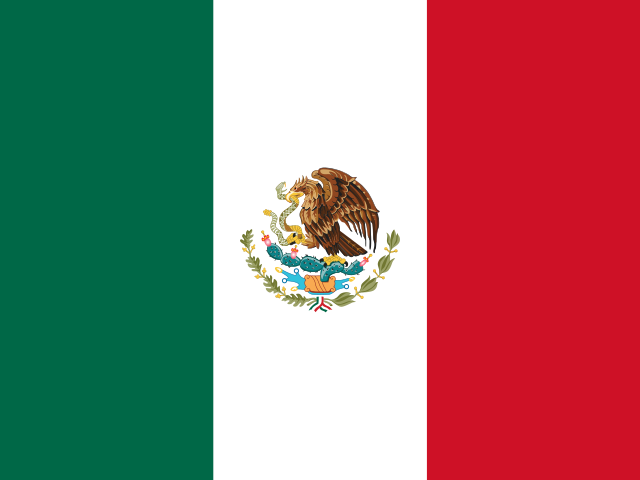
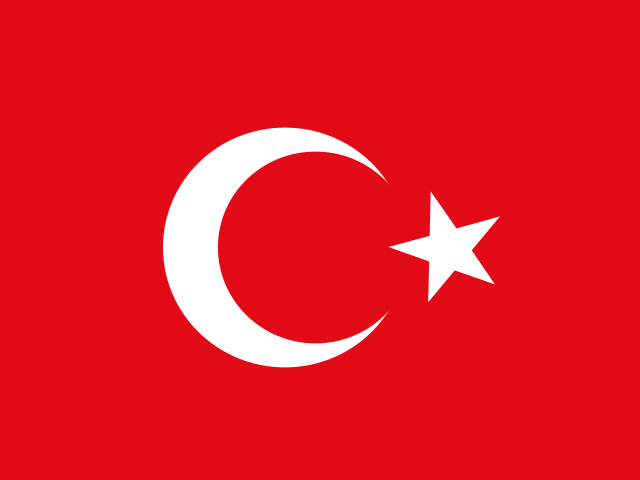
Three takeaways. (1) Life expectancy: converging. At ≈ 78 years, above Brazil and Mexico, below Germany (≈ 81).
(2) Extended coverage. The reform has brought Türkiye close to universal coverage, like the Brazilian SUS.
(3) Moderate spending. Health spending remains lower than in Europe — an efficient system under pressure.
International comparison — health
| Country | Life expectancy | Health spending (% GDP) | System |
|---|---|---|---|
| Germany | ≈ 81 years | ≈ 11.7% | insurance (Bismarck) |
| European Union | ≈ 81.5 years | ≈ 10.4% | universal |
| Brazil | ≈ 75-76 years | ≈ 9-10% | universal (SUS) |
| Mexico | ≈ 75 years | ≈ 6% | fragmented |
| Türkiye | ≈ 78 years | moderate | universal (reformed) |



Sources: WHO, OECD, TÜİK — latest realized values available. "≈" denotes a rounding.
Data mobilized (data-journalism base)
| Data | Value | Source |
|---|---|---|
| Life expectancy | ≈ 78 years | WHO / TÜİK (Citoyen chart) |
| Coverage | universal (2000s reform) | Ministry of Health |
| Health spending / GDP | moderate (< OECD) | OECD / WHO |
| Disparities | regional, income, refugees | analyses |
| Pressure | inflation, demand | analyses |
Sources (national analyses and references)
Ministry of Health · TÜİK · WHO · OECD · World Bank.
Methodological note — the synthesis keeps sourced facts distinct from assessments, stays neutral, dates each figure, and does not extrapolate beyond the sources. All values are the latest realized observation available (no forecast). Note generated by AI, human review required. Same safeguards as the rest of the observatory.