Education — South Africa · Synthesis
High education spending for weak results and a deeply unequal system — legacy of apartheid — with a crisis in foundational learning (reading).
Citoyen synthesis for the Education category in South Africa. Anchored on sector data (Department of Basic Education, Stats SA, UNESCO, TIMSS/PIRLS). ⚠️ Warning: South Africa does not participate in PISA; comparisons are based on TIMSS/PIRLS surveys and literacy. All values are the latest available realised observation. Data last updated: June 2026.
1. Current state — where is the South African education system today
High spending for weak results. South Africa devotes a significant share of its budget to education, yet achieves weak results in international comparisons (TIMSS/PIRLS) — an unfavourable cost-to-outcome ratio, signalling efficiency problems.
A foundational learning crisis. Surveys (PIRLS) have shown that a majority of 10-year-olds cannot read well enough to understand — a basic learning crisis, among the most severe ever measured.
A deeply unequal system. The system is marked by deep inequalities, a direct legacy of apartheid: the gap between well-resourced schools (former white schools, private) and under-resourced schools (townships, rural areas), along racial and income lines (see Social Cohesion category).
Broadly extended access. Access to basic schooling is wide, and the literacy rate is relatively high for a middle-income country — the challenge is quality and equity.
A link with unemployment. Weak learning outcomes and skills mismatch feed mass unemployment, especially among youth (see Labour category).
“South Africa spends a great deal on education, but results remain among the weakest in the world.”
2. Outlook — where is the system headed
Resolving the reading crisis. Improving foundational learning (reading, numeracy) is the central challenge — a prerequisite for any progress in human capital.
Reducing inequalities. Closing the gap between well-resourced and under-resourced schools, a legacy of apartheid, is a major equity challenge.
Skills and employment. Linking education and training to the needs of the economy, to reduce youth unemployment (see Labour category), is crucial.
Spending efficiency. Improving the efficiency of already high spending (management, teachers) is a governance challenge.
Open questions. Three trade-offs will shape the decade: (1) resolving the reading crisis; (2) reducing inequalities; (3) linking education and employment.
“A majority of 10-year-olds cannot read properly — a learning crisis, a legacy of apartheid.”
3. International comparison — South Africa among its peers
Placed in context, South Africa has high spending for weak and very unequal results — a system in need of deep reform.
Three lessons. (1) Weak results. In TIMSS/PIRLS surveys, South Africa ranks among the weakest — the absence of PISA limits direct comparisons.
(2) High spending, low efficiency. Unlike several emerging economies, the issue is not the level of spending but its efficiency and equity.
(3) Inherited inequalities. The gaps between schools, inherited from apartheid, are among the most pronounced — a distinctive feature.
International comparison — education
| Country | PISA maths (2022) | Spending | Inequalities |
|---|---|---|---|
| France | ≈ 474 | high | moderate |
| European Union | ≈ 472 (OECD avg.) | high | mixed |
| Mexico | ≈ 395 | moderate | high |
| Brazil | ≈ 379 | moderate | high |
| South Africa | not a participant ⚠️ | high | deep (apartheid) |
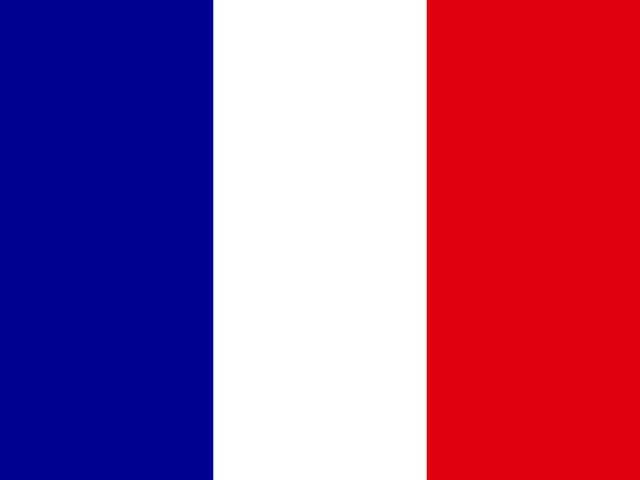
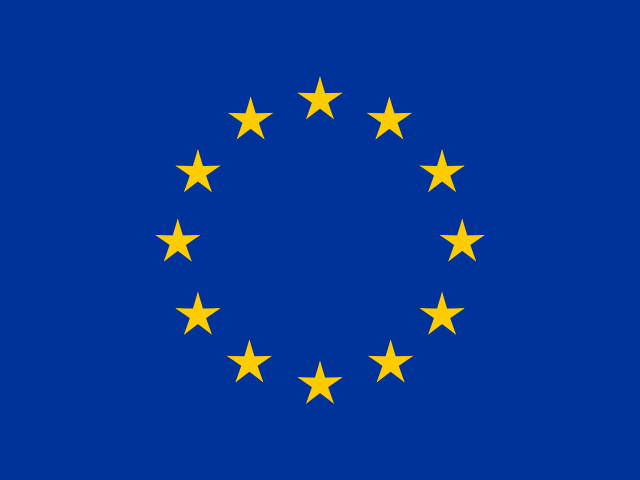
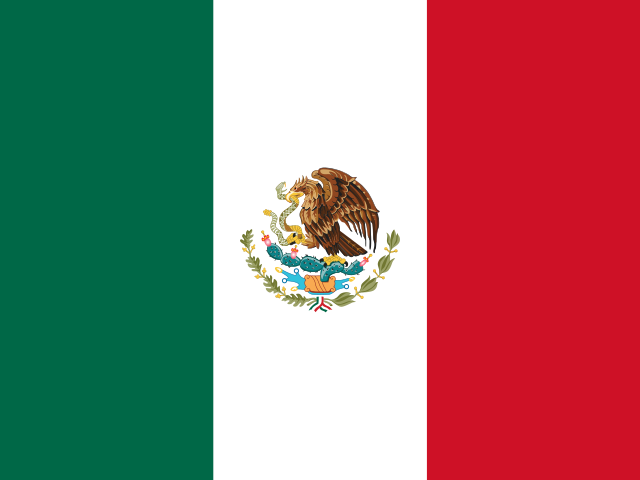
⚠️ South Africa does not participate in PISA; comparisons are based on TIMSS/PIRLS. Sources: Department of Basic Education, UNESCO. "≈" indicates rounding.
Data used (data journalism baseline)
| Data | Value | Source |
|---|---|---|
| Education spending | high (share of budget) | Department of Basic Education |
| Learning outcomes (reading) | crisis (PIRLS) | PIRLS |
| School inequalities | deep (apartheid legacy) | analyses |
| Literacy | relatively high | UNESCO / Stats SA |
| Link with unemployment | skills mismatch | Stats SA |
Sources (national analyses and references)
Department of Basic Education · Stats SA · UNESCO · TIMSS/PIRLS (international learning assessments). South Africa does not participate in PISA.
Methodology note — the synthesis distinguishes sourced facts from assessments, remains neutral, dates each data point, and does not extrapolate beyond the sources. ⚠️ Absence of PISA; comparisons via TIMSS/PIRLS and literacy. All values are the latest available realised observation (no forecast). Note generated by AI, human review required. Same safeguards as the rest of the observatory.