
Social cohesion — South Africa · Synthesis
The most unequal country in the world — an apartheid legacy never remedied — with widespread poverty, mass unemployment and vast social grant programmes that cushion without correcting.
Citoyen synthesis for the Social cohesion and inequality category in South Africa. Grounded in the sector's quantitative data (Stats SA, World Bank, OECD). All values are the latest realized observation available — never a forecast. Assessments are kept distinct from sourced facts. Data last updated: June 2026.
1. State of play — where social cohesion stands
The most unequal country in the world. South Africa has the highest Gini index in the world (of the order of 0.63, World Bank) — a record inequality, an apartheid legacy never remedied, three decades after its end.
Inequalities structured by race. Income, wealth, employment (cf. the Labor category) and access inequalities remain deeply structured by race: despite the emergence of a Black middle class and elite, the gap inherited from apartheid has not closed.
Widespread poverty. Poverty remains widespread, fuelled by mass unemployment (cf. the Labor category) — a majority of the population depends, wholly or in part, on transfers.
Vast social grant programmes. South Africa has vast social grant programmes ("social grants", child support grants, old age pensions) that reach a large part of the population and cushion poverty — an essential safety net, but one that does not correct structural inequalities.
Mass unemployment aggravating the situation. Mass unemployment (≈ 33%, cf. the Labor category) is the primary driver of poverty and inequality, and the central challenge to cohesion.
“South Africa is the most unequal country in the world, three decades after the end of apartheid.”
2. Outlook — where social cohesion is heading
Creating jobs. Reducing inequality and poverty depends above all on job creation (cf. the Labor and Economy categories) — the central structural lever.
Reducing racial inequalities. Addressing the inequalities inherited from apartheid (income, wealth, education, cf. the Education category) is a long-term justice and cohesion challenge.
Sustaining and targeting grants. Maintaining and financing social grants, which cushion poverty, in a context of constrained public finances (cf. the Economy category), is a challenge — the debate on a basic income is open.
Cohesion and services. Access to basic services (housing, water, electricity, cf. the Housing and Environment categories) is an inclusion challenge.
The open questions. Three issues will shape the period: (1) creating jobs to reduce poverty and inequality; (2) addressing racial inequalities; (3) sustaining social grants.
“Inequalities remain deeply structured by race: a legacy that has not closed.”
3. International comparison — South Africa among its peers
Placed in its environment, South Africa is the most unequal country in the world — an extreme case.
Three takeaways. (1) Inequality: the highest in the world. With a Gini of ≈ 0.63, South Africa surpasses Brazil (≈ 0.52) and every other country — a record.
(2) A unique racial dimension. Inequalities structured by race, an apartheid legacy, are a specificity.
(3) An extensive social safety net. The vast grants cushion poverty without correcting structural inequalities — a studied case.
International comparison — inequality
| Country | Gini | Poverty | Feature |
|---|---|---|---|
| France | ≈ 0.29 | low | strong redistribution |
| India | very high (wealth) | declining | caste |
| Mexico | ≈ 0.42–0.45 | declining | North-South |
| Brazil | ≈ 0.52 | declining | racial |
| South Africa | ≈ 0.63 (the highest) | widespread | racial (apartheid) |


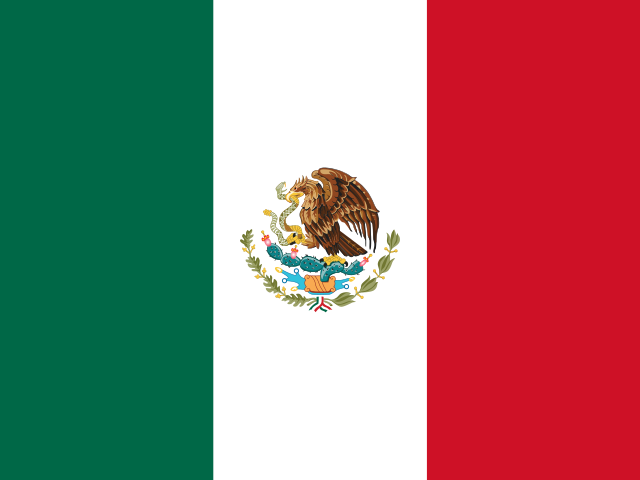
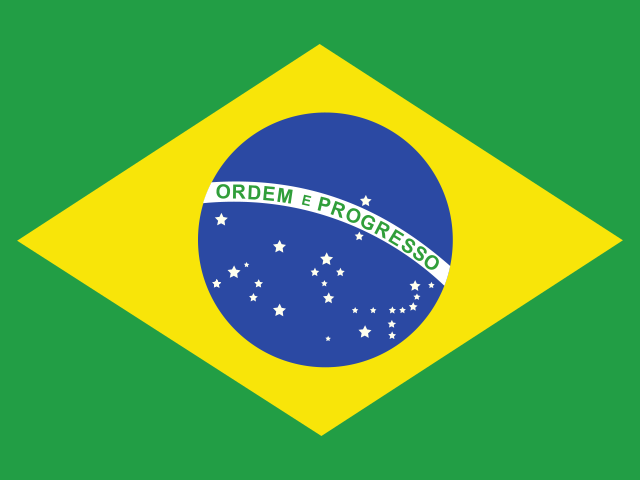
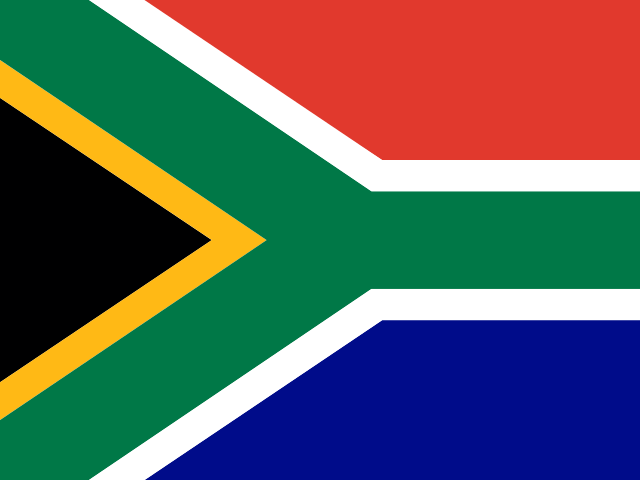
Sources: World Bank (Gini), Stats SA, OECD. South Africa has the highest Gini index in the world. "≈" denotes a rounding.
Data mobilized (data-journalism base)
| Data | Value | Source |
|---|---|---|
| Gini index | ≈ 0.63 (highest in the world) | World Bank / Stats SA (Citoyen chart) |
| Inequalities | structured by race (apartheid) | Stats SA |
| Poverty | widespread (linked to unemployment) | Stats SA (Citoyen chart) |
| Social grants | extensive (social grants) | SASSA |
| Unemployment | driver of poverty (≈ 33%) | Stats SA |
Sources (national analyses and references)
Stats SA (income, poverty, inequality) · SASSA (social grants) · World Bank (Gini, poverty) · OECD.
Methodological note — the synthesis keeps sourced facts distinct from assessments, stays neutral, dates each figure, and does not extrapolate beyond the sources. All values are the latest realized observation available (no forecast). Note generated by AI, human review required. Same safeguards as the rest of the observatory.